71.4 F
San Diego
Monday, June 1, 2026
Tang Soo Do Karate Social Media
$0.00

No products in the cart.

Home Blog

The Shocking Truth About Why Most Students Quit Karate

Was this you at some point in your karate journey?
You started excited.

New uniform.
New belt.
New goals.
Maybe even dreams of becoming a Black Belt one day.

But then reality hit…

Classes got harder.
Techniques felt confusing.
Progress felt slow.
Life got busy.
Motivation started to fade.

And for a moment, you wondered…

β€œCan I really do this?”

The truth is, most students don’t quit because they’re weak.

They quit because they forget that struggle is part of the journey.

Every Black Belt has faced frustration.
Every Black Belt has had hard days.
Every Black Belt has had moments where quitting felt easier.

The difference?

They kept showing up.

In Tang Soo Do, we don’t just train kicks, punches, forms, and self-defense.

We train patience.
We train discipline.
We train perseverance.
We train the mindset to keep going when things get hard.

πŸ₯‹ A White Belt who never quits becomes a Black Belt.
πŸ₯‹ A hard class builds character.
πŸ₯‹ A setback is not failure β€” it’s a lesson.
πŸ₯‹ Success belongs to those who stay on the mat.

So if you’ve ever felt discouraged, frustrated, or close to quitting…

You’re not alone.

Keep stepping on the mat.
Keep learning.
Keep growing.

One class at a time.

Was this you at some point in your journey?
Like if you’ve been there.
Share this with someone who needs encouragement today.

The Ripple of Kindness

In a bustling dojang, the sun rose and cast warm rays onto the training floor. Inside, the air buzzed with energy as students prepared for their morning practice. Among them was a blue belt with a determined spirit but a struggle he kept hidden: his mind was burdened with the stress of school, feelings of inadequacy, and a sense of loneliness he couldn’t shake.

He took his place in line and bowed, but his heart wasn’t in it that day. His kicks felt weak, his stances were unsteady, and frustration welled up in his eyes. The other students noticed, but most were too focused on their practice to pay much attentionβ€”except for a black belt known for kindness and an unwavering spirit.

Recognizing the look of struggle in his eyes, the black belt approached the blue belt after the warm-up. β€œYou’re working hard out there, but it looks like something’s weighing you down. Want to practice together?”Surprised but grateful, the blue belt nodded. As they trained side by side, the black belt gave simple but encouraging tips, praised his strengths, and gently guided him through his weaknesses. Most importantly, they listened as the blue belt shared what was on his mind, offering words of understanding and support.

After practice, the black belt invited him to join a group of friends for lunch. They shared laughs, stories, and a sense of belonging that had been missing from the blue belt’s life. By the time he left, he felt lighter and more inspired.

In the following weeks, his focus and energy gradually returned. The act of kindness had reignited his spirit, and he trained with a renewed sense of purpose. He pushed himself harder, not just for himself but to honor the support he had received.

Years later, he achieved his black belt, and his journey came full circle when he noticed a struggling white belt, much like he had once been. Remembering the kindness he had been shown, he approached the student, ready to offer a listening ear and a helping hand.

That single act of kindness had set off a ripple effect, one that would inspire many students in the dojang to be there for each other. It became a lesson woven into the fabric of the dojang, proving that in Tang Soo Do, strength isn’t just in kicks and punches, but also in the compassion we show our fellow martial artists.

Β© TANGSOODOKARATE.COM 2024. All rights reserved.

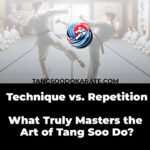
Technique vs. Repetition

πŸ₯‹πŸ’­ What Truly Masters the Art of Tang Soo Do?

As a Tang Soo Do black belt with many years of experience, I’ve often reflected on what truly masters the artβ€”technique or repetition? It’s a question that has sparked countless debates within dojangs worldwide, and today, I want to pose it to you: Which do you believe is more important for achieving mastery, perfecting technique or embracing repetition? πŸ€”

The Case for Technique 🎯

When we talk about technique, we’re referring to the precision, form, and understanding behind every movement. Proper technique is the foundation of all martial arts. Without it, even the most powerful punch can be ineffective or, worse, harmful to the practitioner.

Consider the way we execute a simple front kick, or Ahp Chagi. When performed with proper technique, this kick becomes a weapon of precisionβ€”targeting vital points with maximum efficiency while minimizing the risk of injury to oneself. The alignment of the body, the correct positioning of the foot, the control in the deliveryβ€”all these elements are crucial. Mastery of technique ensures that every movement is purposeful and executed with intent. 🎯

Imagine a student who practices their forms, or hyungs, with laser-like focus on technique. Every stance is deep, every block is strong, and every strike is exact. This student may not perform as many repetitions as others, but each one is executed with such precision that it imprints muscle memory of perfection. In the heat of competition or real-life self-defense, this mastery of technique could make the difference between success and failure. πŸ₯‡

The Case for Repetition πŸ”

On the other side of the debate, we have repetition. The philosophy here is simple: “Practice makes perfect.” In Tang Soo Do, repetition is the key to ingraining techniques into our muscle memory so deeply that they become second nature. Repetition builds endurance, speed, and automaticityβ€”qualities essential for real-world application. πŸš€

Consider a black belt candidate preparing for their Dan test. The sheer volume of techniques, forms, and self-defense scenarios they must demonstrate can be overwhelming. To perform at their best, they must practice each technique thousands of times. This repetition not only improves their physical performance but also builds confidence. When you’re under pressure, it’s not conscious thought but ingrained habit that guides your actions. 🧠πŸ’ͺ

Think about sparring, or Dae Ryun, where the unpredictable nature of an opponent’s moves demands an automatic response. Here, repetition reigns supreme. The more you practice your combinations, blocks, and counters, the faster and more effective your reactions become. Repetition turns good techniques into great ones and great techniques into unstoppable forces. πŸ”₯

Finding the Balance βš–οΈ

So, which is more importantβ€”technique or repetition? The truth is, they are two sides of the same coin. Without technique, repetition can reinforce bad habits, making it harder to correct mistakes later on. Without repetition, even the best techniques can falter under pressure. πŸ’‘

As Tang Soo Do practitioners, we should strive to find the balance between these two elements. We must first learn to perfect our techniques under the watchful eyes of our instructors, ensuring every movement is as close to perfection as possible. Then, we must practice those techniques over and over until they become second nature. πŸ₯‹πŸ”„

A well-rounded martial artist understands that mastery is not about choosing one over the other but about integrating both into their training regimen. When you step into the dojang, ask yourself: Am I focusing on my technique today? Or is it time to embrace the grind of repetition? The answer should be a balance of both. βš”οΈ

Your Turn to Decide πŸ”

Now, I turn the question to you, my fellow Tang Soo Do practitioners: Do you believe technique or repetition holds more weight in mastering our art? Share your thoughts and experiencesβ€”after all, the path to mastery is not one we walk alone, but together as a martial arts community. πŸ₯‹πŸ’¬

#TangSooDo #MartialArts #TechniqueVsRepetition #BlackBeltWisdom #KarateMastery #MartialArtsDebate

Β© TANGSOODOKARATE.COM 2024. All rights reserved.

The Shocking Truth: Why Tang Soo Do Karate Isn’t in the Olympics

Ever wondered why Tang Soo Do, a traditional Korean martial art, isn’t in the Olympics? Here are the surprising reasons! πŸ‘‡

  1. Recognition and Standardization: The IOC requires sports to have a standardized set of rules and a unified international governing body. Tang Soo Do lacks this global oversight, making it ineligible for Olympic consideration.
  2. Sport vs. Traditional Martial Art: Tang Soo Do emphasizes traditional techniques, forms (hyung), and philosophies. Unlike Taekwondo and Judo, it hasn’t adapted to the competitive sports framework of the Olympics.
  3. Popularity and Global Reach: Olympic sports need a broad and diverse international following. While Tang Soo Do is practiced worldwide, it doesn’t match the global recognition and participation levels of Taekwondo, Judo, or Karate.
  4. Lobbying and Support: Strong lobbying is crucial for Olympic inclusion. Taekwondo benefited from significant support from the Korean government and the World Taekwondo Federation. Tang Soo Do hasn’t had the same coordinated efforts.

Despite its rich history and dedicated following, these factors keep Tang Soo Do out of the Olympic Games. 😲

Meanwhile, these martial arts are recognized and competed in at the Olympic level:

  • Judo: A Japanese martial art focusing on throws and grappling techniques. Olympic sport since 1964.
  • Taekwondo: Known for its dynamic kicking techniques. Part of the Olympics since 2000.
  • Boxing: A combat sport with Olympic history dating back to 1904.
  • Wrestling: Includes both Greco-Roman and Freestyle, part of the Olympics since 1896.
  • Karate: Debuted at the 2020 Tokyo Olympics with Kumite (sparring) and Kata (forms).

#TangSooDo #MartialArts #OlympicSnub #Karate #MartialArtsCommunity #TraditionalMartialArts #TangSooDoJourney #OlympicGames #MartialArtsHistory #ShockingTruth #OlympicExclusion #Judo #Taekwondo #Boxing #Wrestling #Karate

Β© TANGSOODOKARATE.COM 2024. All rights reserved.

Building Strength in Tang Soo Do Karate Kicks

πŸ₯‹πŸ’₯ Building Strength in Tang Soo Do Karate Kicks πŸ’₯πŸ₯‹

Tang Soo Do, a traditional Korean martial art, emphasizes powerful and precise kicking techniques. As a black belt, the journey to mastering and strengthening your kicks involves a combination of proper technique, targeted exercises, and consistent practice. Here’s a comprehensive guide to developing strength in your Tang Soo Do kicks.

1. Understanding the Basics of Kicking Techniques

Before diving into strength-building exercises, ensure that your foundational techniques are solid. The most common kicks in Tang Soo Do include:

  • Front Kick (Ahp Cha Ki)
  • Roundhouse Kick (Dollyo Cha Ki)
  • Side Kick (Yup Cha Ki)
  • Back Kick (Dwi Cha Ki)
  • Hook Kick (Huryeo Cha Ki)

Proper form is crucial for generating power and preventing injury. Focus on the following key points:

  • Chambering: Properly chamber your leg to gather potential energy.
  • Extension: Fully extend your leg to maximize reach and impact.
  • Re-chambering: Quickly bring your leg back after the kick to maintain balance and readiness for the next move.
  • Hip Rotation: Engage your hips for additional power, especially in kicks like the roundhouse and side kick.
  • Foot Positioning: Ensure your foot is correctly positioned to avoid injuries and maximize impact.

2. Strength-Building Exercises πŸ‹οΈβ€β™‚οΈ

To build strength in your kicks, incorporate the following exercises into your routine:

A. Leg Strengthening Exercises
  1. Squats:
    • Perform traditional squats to strengthen your quadriceps, hamstrings, and glutes.
    • Incorporate variations like jump squats and single-leg squats for added intensity.
  2. Lunges:
    • Forward, reverse, and side lunges help build strength in your legs and improve balance.
    • Use weights for increased resistance.
  3. Calf Raises:
    • Strengthen your calves to enhance the stability and power of your kicks.
  4. Leg Press:
    • Utilize the leg press machine to target your lower body muscles.
B. Core Strengthening Exercises πŸ’ͺ
  1. Planks:
    • Engage your core muscles to improve overall stability and power in your kicks.
  2. Russian Twists:
    • Strengthen your obliques, which are crucial for hip rotation in kicks.
  3. Leg Raises:
    • Target your lower abs to help with the upward motion in kicks like the front kick.
C. Plyometric Exercises ⚑
  1. Box Jumps:
    • Improve explosive power and leg strength.
    • Ensure proper form to avoid injuries.
  2. Plyometric Lunges:
    • Add a jump to your lunges to build explosive strength.
  3. Bounding:
    • Perform bounding exercises to enhance your leg strength and overall explosiveness.

3. Flexibility Training 🀸

Flexibility is vital for high and powerful kicks. Incorporate regular stretching into your routine:

  • Dynamic Stretching: Perform dynamic stretches like leg swings and hip circles before your workout to warm up your muscles.
  • Static Stretching: After training, use static stretches to improve flexibility. Focus on hamstrings, quadriceps, hip flexors, and groin muscles.
  • Yoga: Consider adding yoga to your routine to enhance flexibility and balance.

4. Technical Drills πŸ₯‹

  1. Kicking Drills:
    • Practice your kicks repeatedly on both legs to build muscle memory and strength.
    • Use targets like focus pads or kicking shields to work on precision and power.
  2. Bag Work:
    • Heavy bag training helps you develop the strength and endurance needed for powerful kicks.
    • Vary your kicks and combinations to simulate real-life scenarios.
  3. Partner Drills:
    • Practice with a partner to improve timing, accuracy, and power.
    • Work on defensive and counter-kicking drills to enhance your overall skill set.

5. Consistency and Progressive Overload πŸ“ˆ

Building strength in your kicks requires consistency. Incorporate strength training and kicking drills into your regular training schedule. Use progressive overload principles by gradually increasing the intensity, duration, and resistance of your exercises to continue making gains.

6. Nutrition and Recovery 🍎πŸ₯—

Fuel your body with a balanced diet rich in protein, carbohydrates, and healthy fats to support muscle growth and recovery. Stay hydrated and ensure you get adequate rest to allow your muscles to repair and grow stronger.

7. Mental Focus and Visualization πŸ§˜β€β™‚οΈ

Mental strength is equally important. Visualize yourself executing powerful and precise kicks. Practice mindfulness and meditation to enhance your focus and reduce stress, which can impact your performance.

Conclusion

Building strength in your Tang Soo Do kicks involves a holistic approach that combines proper technique, targeted strength exercises, flexibility training, and mental focus. By incorporating these elements into your training regimen, you will see significant improvements in the power and precision of your kicks, helping you excel in your martial arts journey.

Remember, the journey to mastery is continuous. Stay dedicated, train consistently, and always seek to improve. Tang Soo!

#MartialArts #TangSooDo #KarateKicks #StrengthTraining #BlackBelt #KickPower #MartialArtsLife #FitnessGoals #KarateStrength #ViralMartialArts #TangSooDoLife


Β© TANGSOODOKARATE.COM 2024. All rights reserved.

Overcome Self-Doubt, Unlock Limitless Potential

In the journey of Tang Soo Do, self-doubt can be a formidable opponent. But remember, every master was once a beginner who never gave up. πŸ₯‹πŸ’ͺ

🌱 Embrace Self-Belief: The first step to greatness is believing in your own potential. When you conquer self-doubt, you pave the way for limitless growth. 🧠✨

🌳 Trust the Process: With each kick, punch, and form, you are sculpting not just your body, but your spirit. Trust the journey, and the results will follow. πŸš€πŸ›€οΈ

🌈 Rise Above Challenges: Challenges are opportunities in disguise. Face them head-on with the indomitable spirit of Tang Soo Do. πŸ’₯🦁

🌟 Wisdom of the Ancients: “The only limit to our realization of tomorrow is our doubts of today.” – Franklin D. Roosevelt πŸŒžπŸ“œ

πŸ₯‹ Keep Kicking Forward: Every step, every practice session, and every drop of sweat is a testament to your dedication. Keep pushing forward! πŸš€πŸ‘£

πŸ”“ Unlock Your Potential: Your mind and body are capable of extraordinary things. Believe, train, and achieve! 🌟πŸ”₯

Embrace the Journey with Your White Belt!

As a Tang Soo Do black belt with many years of experience, I can proudly say that the white belt holds profound significance when you start your journey as a Tang Soo Do practitioner. Here’s why you should be proud of that white belt:

🌱 Symbol of New Beginnings

The white belt marks the start of your martial arts journey. Every expert was once a beginner, and this belt sets the stage for your growth and transformation.

πŸ› οΈ Foundation of Knowledge

The white belt phase is where you build fundamental skills that will support your entire Tang Soo Do practice. These basics are the bedrock of your martial arts education.

πŸ™ Attitude of Humility

Wearing the white belt fosters humility. It reminds you to approach learning with an open mind, free from ego. This humility is crucial for continuous improvement.

🀝 Sense of Community

As a white belt, you become part of the Tang Soo Do community, forming new friendships and bonds. The support and camaraderie of this community are invaluable.

πŸ’ͺ Recognition of Courage

Starting something new requires courage. The white belt is a badge of bravery, representing your decision to step out of your comfort zone and challenge yourself.

🌟 Inspiration for Others

Your white belt journey can inspire others considering their own path in Tang Soo Do. Your progress and dedication serve as a beacon of motivation.

In essence, the white belt is more than just a piece of cloth; it’s a symbol of potential and the promise of what you can achieve through dedication and hard work. Be proud of your white belt, for it marks the beginning of a journey that will shape not only your martial arts skills but also your character and life.

🌟πŸ₯‹ Ready to start your own journey? Look for a Tang Soo Do school near you and take the first step today! πŸ₯‹πŸŒŸ

Grand Master Young H. Kwon: A Legacy of Excellence in Traditional Korean Martial Arts

Pioneering Tradition in Philadelphia and San Diego πŸ™οΈπŸŒ„

Grand Master Young H. Kwon, an 8th-degree Black Belt, has been a trailblazer in traditional Korean Martial Arts across Philadelphia, PA, and San Diego, CA. His leadership and expertise have cultivated numerous national and international champions, masters, and instructors. Under his guidance, the academy has become a symbol of excellence and tradition in the martial arts community. πŸ’ͺ

Founder of Pilsung Martial Arts Association πŸ…

Grand Master Young H. Kwon is not only a pioneer of traditional Korean martial arts in the Philadelphia, PA, and San Diego, CA areas but also the founder of the widely recognized and respected Pilsung Martial Arts Association. Founded in 2009, the association embodies the spirit of β€œPilsung,” meaning β€œCertain Victory.” πŸ†

A Journey of Dedication and Mastery πŸ›€οΈ

Trained under Hwang Kee in Moo Duk Kwon, Seoul, South Korea, Grand Master Kwon, alongside his brother Young Kook Kwon and fellow Master Blackbelt classmates, became a charter member of the World Tang Soo Do Association. This journey led to the founding of the United Martial Arts Federation in 1986 and later the Pilsung Martial Arts Association. πŸ₯‡

The Evolution of Pilsung Moo Do 🌱

Since 1990, Grand Master Kwon has been dedicated to developing Pilsung Moo Do. Drawing inspiration from traditional Soo Bahk Do, Tang Soo Do, and Taekwondo, he has blended these with modern, dynamic martial arts techniques. His mission has been to enhance traditional material, creating a system beneficial for modern practitioners as both a method of self-defense and a life-enhancing system. πŸ₯‹βœ¨

Celebrating a Decade of Pilsung Moo Do πŸŽ‰

In 2019, marking the 10th anniversary of the Pilsung Martial Arts Association, the name Pilsung Moo Do (The Martial Art/Way of Certain Victory) was officially adopted as the organization’s core style. This milestone culminated nearly 30 years of development and experience, ushering the association into a new era. 🌟

A Commitment to Excellence πŸ“ˆ

Kwon’s Black Belt Academy’s instruction provides unique mental and physical coordination, emphasizing individual character development, integrity, and respect for others. Grand Master Kwon’s dedication to his students is matched by their commitment to their training, ensuring a balanced approach to physical, mental, and spiritual growth. πŸ§˜β€β™‚οΈπŸ’ͺ

Embracing the Martial Arts Philosophy πŸ“œ

Following the philosophy of the five codes and seven tenets, students are encouraged to integrate martial arts practice into their daily lives. Grand Master Kwon advises new students to commit fully to their training, recognizing and correcting mistakes, and monitoring their overall growth and strength. πŸ”„

Join the Legacy at Kwon’s Black Belt Academy 🌟

Experience the rich tradition and modern excellence of Pilsung Moo Do at Kwon’s Black Belt Academy in Chula Vista, California. Under the guidance of Grand Master Young H. Kwon, embark on a journey of self-discovery, discipline, and certain victory. πŸ₯‹πŸŒ 

Discover the Rich Heritage of Tang Soo Do!

Tang Soo Do is more than just a martial artβ€”it’s a journey through history, culture, and personal growth. Here’s a deeper look into its origins and the meanings behind its name:

🌐 Ancient Korean Roots: Dating back over 2,000 years, Tang Soo Do is rooted in ancient Korean martial arts like Taekkyon and Subak. πŸ₯‹ These early forms were known for their sophisticated kicking techniques and fluid movements, which are still integral to Tang Soo Do today.

πŸ“œ Three Kingdoms Period (57 BC – 668 AD): The Hwarang warriors of the Silla Kingdom practiced early forms of martial arts that influenced Tang Soo Do. They trained in Hwarangdo, which combined physical training with moral and philosophical teachings. πŸ’ͺ🧠

🏯 Unified Silla and Goryeo Dynasties: During these periods, martial arts continued to evolve and integrate elements from neighboring countries, preserving and refining Korean martial traditions. 🌏

🏰 Joseon Dynasty (1392-1910): The “Muye Dobo Tongji” martial arts textbook, created in 1790, documented many techniques and forms that influenced future martial arts generations. πŸ“š

πŸ‡―πŸ‡΅ Japanese Occupation (1910-1945): Despite suppression, Korean martial artists were exposed to Japanese Karate and Judo, shaping the development of modern Korean martial arts. πŸ₯‹

πŸ‘¨β€πŸ« Hwang Kee and Moo Duk Kwan: In 1945, Hwang Kee founded the Moo Duk Kwan, integrating Taekkyon, Kung Fu, and Karate into a cohesive system, giving birth to Tang Soo Do. 🌟

What Does Tang Soo Do Mean?

唐 Tang: Refers to the Tang Dynasty of China, symbolizing Chinese martial arts influence. πŸ‡¨πŸ‡³

手 Soo: Means “hand” in Korean, highlighting the importance of hand techniquesβ€”punches, strikes, blocks, and grappling. βœ‹πŸ€›

道 Do: Translates to “way” or “path,” representing the philosophical journey of self-improvement and mastery in both martial arts and life. πŸ›€οΈπŸŒ 

Philosophical Foundations

Tang Soo Do embodies virtues such as:

  • Integrity 🧭
  • Concentration 🧠
  • Perseverance πŸ’ͺ
  • Respect and Obedience πŸ™
  • Self-Control βš–οΈ
  • Humility 🌾
  • Indomitable Spirit πŸ”₯

Join us on this incredible journey of martial arts and self-discovery! 🌟

Discover the Animal Within with Tang Soo Do!

Tang Soo Do, a traditional Korean martial art, draws inspiration from the natural movements and characteristics of animals, much like many Chinese martial arts. Here’s a detailed look:

🐯 Tiger

  • Philosophy: Power, strength, and ferocity. A symbol of courage and determination.
  • Techniques: Emphasizes powerful, direct movements. Strong, forceful strikes, low stances, and aggressive forward motions. The Tiger stance (Beom Seogi) is low and stable, ideal for powerful strikes.

🦒 Crane

  • Philosophy: Grace, balance, and precision. Symbolizes calmness and strategic movement.
  • Techniques: High stances and controlled, precise kicks. Light and balanced movements, using the Crane stance (Hakdari Seogi), characterized by standing on one leg. Enhances balance and coordination.

🐍 Snake

  • Philosophy: Flexibility, speed, and subtlety. Emphasizes swift, unpredictable movements.
  • Techniques: Fluid, continuous motions, striking vital points, and using evasive maneuvers. Quick, snapping strikes and coiling, circular motions to deflect attacks and strike from unexpected angles.

πŸ‰ Dragon

  • Philosophy: Wisdom, power, and fluidity. Embodies a balance of hard and soft techniques.
  • Techniques: Strength and flexibility with circular and spiraling movements. Includes spinning kicks, circular blocks, and flowing transitions, reflecting the dragon’s ability to move seamlessly and powerfully.

πŸ† Additional Inspirations

  • Leopard: Speed and agility with rapid strikes and quick footwork.
  • Eagle: Keen vision and swift attacks from above, reflected in jumping techniques and high, swooping strikes.
  • Mantis: Precise and calculated movements, mimicking the praying mantis in timing and accuracy in strikes and defense.

Forms (Hyung)

  • Pyung Ahn Forms: Inspired by the crane, focusing on balance, precision, and stability.
  • Bassai (Pal Che): Represents breaking through obstacles, with tiger-like power and determination.

Practical Application

Tang Soo Do students embody these animal characteristics in their physical techniques and mental approach to training and combat. This integration develops a well-rounded skill set including strength, agility, balance, and strategic thinking.

Conclusion

While Tang Soo Do may not emphasize animal mimicry as much as some Chinese martial arts, the influence contributes to the depth and richness of its techniques and forms. This blend of animal-inspired movements helps practitioners develop a versatile and effective martial arts style.